Skip to content
🚛 Flat Rate Shipping $17.95+ GST For Metro & standard delivery zones! Excludes remote/regional and high-cost postcodes (including parts of QLD, WA, NT & TAS), and bulky or heavy items. Online only. Learn More
11

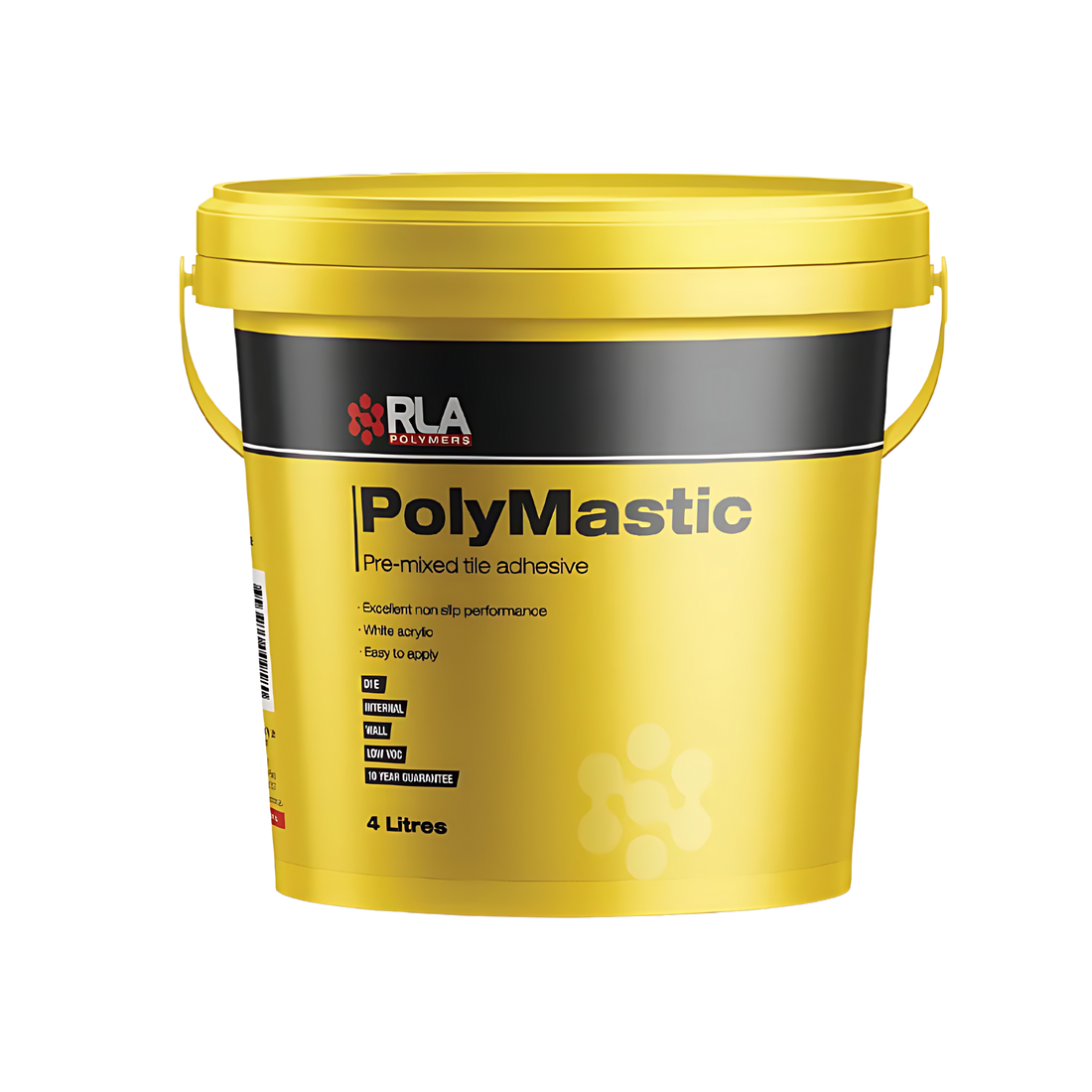
RLA Polymastic

Trade quote

Custom pricing available

Tell us what you need and we'll come back with a quote.

Custom trade quote

Share your quantity and project details for a tailored quote.

Step 1: Quick quote

Step 2: Business and delivery details

Pre-mixed, D1TE-classified acrylic adhesive for internal wall tiling, offering superior non-slump hold for ceramic, mosaic, and large format tiles.
Vendor: RLA
SKU: TILEADRLAPOLY/15
Availability: Out Of Stock
$112.91
$112.91
Prices do not include GST
Shipping & Delivery

Flat-rate shipping $17.95 + GST (metro and standard zones). Excludes remote/regional/high-cost postcodes and certain items (DG, oversized, long-length, or bagged products 15 kg+). If your order includes any of these, we will contact you to arrange additional freight charges. Online purchases only.

Tiling internal walls demands an adhesive that holds its position without question. RLA Polymastic delivers this confidence. It is the D1TE-classified, pre-mixed acrylic adhesive designed for porous ceramic, mosaic, and even large format tiles. No slump, excellent workability, and a reliable bond, right from the pail.

Why this product exists

RLA Polymastic is formulated to simplify internal wall tiling. It is a pre-mixed, white acrylic adhesive that eliminates on-site mixing, ensuring consistent workability from start to finish. This formulation focuses on delivering superior non-slump properties, crucial for holding ceramic, mosaic, and specified large format tiles securely on vertical surfaces. Its flexibility accommodates minor substrate movement, maintaining bond integrity in internal applications.

The numbers that matter

The D1TE classification of RLA Polymastic confirms its reduced slip and extended open time. This means less tile sag during installation and more time to precisely adjust each tile. With an open time of 30 minutes, installers can efficiently lay tiles within their working rhythm. A drying time of 40 minutes before skinning offers a solid window for placement, leading to reliable grouting in 24 hours.

What it's like to use

Working with RLA Polymastic is straightforward. Apply it directly from the pail with a notched trowel, covering roughly 1m² at a time to prevent premature skinning. For tiles over 300 x 300mm, back-buttering ensures full adhesive coverage and reduces slip. Once placed, press tiles into the wet bed with a sliding action to eliminate voids. Any wet excess cleans up easily with a damp cloth, and tools rinse with water, streamlining the job site.

Where this product excels

RLA Polymastic excels in diverse internal wall tiling scenarios. It provides a secure, flexible bond for porous ceramic and mosaic tiles in bathrooms, laundries, and kitchens. Its superior non-slump properties are particularly valuable when fixing large format wall tiles to common internal substrates like plasterboard, concrete, or rendered surfaces. For internal wet areas, it can bond over RLA wet area membranes, though careful consideration of tile porosity and extended drying times is essential.

Choose this when

  • When: you need a convenient, pre-mixed acrylic adhesive for internal wall tiling.
  • When: installing porous ceramic, mosaic, or selected large format wall tiles.
  • When: superior non-slump performance is critical for vertical applications.

Don't use this when

RLA Polymastic is an internal wall adhesive with specific boundaries.

  • Not for: external applications or floor tiling, where it lacks the necessary resistance to weather or foot traffic.
  • Not for: immersed areas like swimming pools or permanent wet zones.
  • Not for: bonding moisture-sensitive natural stone, as it can cause staining.
  • Not for: large, low-porosity tiles over waterproof membranes without allowing significantly extended drying times, due to reduced moisture escape.
  • Not for: application when ambient or surface temperatures are below 5ºC or above 35ºC.

This adhesive meets D1TE classification, indicating its reduced slip and extended open time. Installation should always be carried out in accordance with AS 3958: 2023 – Installation of Ceramic and Stone Tiles.

RLA Polymastic versus RLA Flex Pro Waterproofing Membrane: Choosing the right RLA product

While both RLA Polymastic and RLA MS Pro Sealant offer reliable adhesion, they serve distinct purposes on a project. RLA Polymastic is a pre-mixed, acrylic adhesive purpose-built for bonding ceramic and mosaic tiles to internal walls. It offers superior non-slump properties for vertical applications and eliminates the need for mixing. In contrast, RLA MS Pro Sealant is a high-performance MS polymer sealant and adhesive designed for flexible joint sealing and bonding across a broader range of substrates and applications, including those requiring weather resistance or higher movement capability. Choose Polymastic for your internal wall tiling jobs where convenience and specific tile bonding characteristics are paramount.

Frequently asked questions

Can RLA Polymastic be used for floor tiling?

No, RLA Polymastic is not suitable for floor tiling applications. It is specifically formulated and classified for internal wall use only, providing essential non-slump properties for vertical surfaces.

Is Polymastic suitable for large format tiles on internal walls?

Yes, Polymastic is designed for large format wall tiling. For tiles larger than 300x300mm, back-buttering is required in addition to trowelling adhesive onto the wall to ensure full coverage and bond strength.

What are the considerations when tiling over waterproof membranes with Polymastic?

Polymastic has limited suitability over approved waterproof membranes. Avoid using large or low porosity tiles over these surfaces and allow significantly longer drying times to ensure proper cure and adhesion.

What is the earliest I can grout after tiling with Polymastic?

Grouting can commence after the adhesive has cured for 24 hours at 23ºC. Ensure tiles are well fixed and will not be displaced during the grouting process.

Applications and benefits

Where RLA Polymastic is used, what it delivers, and who uses it
Application Key benefit Primary trades
Internal wall tiling D1TE classification provides high grab and reduced slump for vertical surfaces. Tilers, Builders, Renovators
Large format wall tiles Flexible and non-slump properties maintain tile position, reducing lippage and movement during cure. Tilers, Architects, Designers
Porous ceramic and mosaic tiles Specifically formulated for reliable bonding to porous tiles. Tilers, Interior Designers

Applying RLA Polymastic: Enhanced Protocols & Best Practices

  1. Surface Preparation

    Ensure substrates are clean, sound and dry. Cure render ≥7 days; mechanically abrade dense/burnished concrete surfaces.

    Pro Tip: Prime highly porous substrates with RLA Porous Primer (~1 L/8 m² per coat).
  2. Trowel Selection & Spreading

    Use an appropriate notched trowel (6 mm typical). Spread no more than ~1 m² at a time to prevent skinning.

    Timing: Open time ~30 minutes; drying time ~40 minutes at ~23 °C, 50% RH.
  3. Tile Placement

    Press tiles into the wet bed with a sliding action for full coverage. Back-butter tiles >300×300 mm or with lugs/grooves.

    Pro Tip: Ensure the final adhesive bed is ≥2 mm; do not place tiles into skinned adhesive.
  4. Curing & Grouting

    Do not disturb tiling for ~24 hours at ~20–23 °C. Commence grouting when tiles are firm and not displaced by tooling.

    Pro Tip: In cool/humid conditions allow extended time before grouting and protect from moisture.

Product limitations

  • Not for: External applications, as Polymastic is formulated exclusively for internal use.
  • Not for: Floor tiling, as it lacks the required properties for horizontal load-bearing surfaces.
  • Not for: Immersed applications, including swimming pools or constantly wet areas beyond typical showers.
  • Not for: Bonding moisture-sensitive natural stone, which can stain or discolour.
  • Limited suitability: Over approved waterproof membranes. Avoid using large and low porosity tiles, and anticipate significantly extended drying times in these scenarios.
  • Temperature restrictions: Do not apply when surface or ambient temperatures are above 35ºC or below 5ºC to ensure proper cure.

Safety and handling

Personal protective equipment

Wear safety glasses with side shields or chemical goggles. Use general protective gloves, such as lightweight rubber gloves. Overalls are recommended. For prolonged exposure or poor ventilation, use a Type A-P Filter respirator.

Ventilation

Use in a well-ventilated area to minimise exposure. Engineering controls should be prioritised to remove hazards at the source.

First aid

  • Eye Contact: Wash out immediately with water. Seek medical attention if irritation persists.
  • Skin Contact: Flush skin and hair with running water. Use soap if available. Seek medical attention for irritation.
  • Inhalation: Remove from contaminated area. No other measures usually necessary.
  • Ingestion: Immediately give a glass of water. If in doubt, contact a Poisons Information Centre or a doctor.

Storage and disposal

Store in original, unopened packaging in a cool, dry area at room temperature, away from direct sunlight and cold floors. Shelf life is 12 months. Recycle containers where possible or dispose of residue at an approved site according to State Land Waste Authority guidelines.

Substrate guide

Proper substrate preparation is critical for the long-term performance of any tiling system. This guide covers specific requirements for common internal wall substrates.

Concrete

Surface prep: Steel-trowelled, burnished, and dense concrete surfaces must be mechanically abraded to roughen them and create a key. All surfaces must be clean, sound, dry, and free from contaminants.

Primer: Optional. Highly porous concrete surfaces require priming with RLA POROUS PRIMER at 1 litre/8m² per coat, allowing it to dry before adhesive application.

Render

Surface prep: Rendered surfaces must be allowed to cure for at least 7 days. Ensure surfaces are clean, sound, dry, and free from contaminants.

Primer: Optional. Highly porous render surfaces require priming with RLA POROUS PRIMER at 1 litre/8m² per coat, allowing it to dry before adhesive application.

Compressed fibre cement sheeting

Surface prep: Ensure surfaces are clean, sound, dry, and free from contaminants. All installations must follow manufacturer recommendations and relevant building codes.

Primer: Optional. Highly porous surfaces require priming with RLA POROUS PRIMER at 1 litre/8m² per coat, allowing it to dry before adhesive application.

Plasterboard

Surface prep: Ensure surfaces are clean, sound, dry, and free from contaminants. All installations must follow manufacturer recommendations and relevant building codes.

Primer: Not required for typical plasterboard, unless unusually porous. Always check for excessive porosity.

RLA wet area membranes

Surface prep: Ensure the membrane is fully cured and free from any contaminants. Adhere to the membrane manufacturer's guidelines for tiling over the system.

Primer: Not required. However, note the limited suitability for Polymastic over membranes, particularly with large or low porosity tiles. Expect significantly longer drying times.

RLA Polymastic Physical Properties

RLA Polymastic Physical Properties
Property Value
Appearance White paste
Physical State Non Slump Paste
Relative Density (Water = 1) 1.6
pH (as supplied) 8.5
Initial Boiling Point and Boiling Range <100 °C
Solubility in Water Miscible
Open Time 30 minutes
Drying Time 40 minutes
Ready for Grouting 24 hours
Classification D1TE
Coverage 9m² using a 6mm notch (per 4 litre pail)
Shelf Life 12 months

RLA Polymastic - Use Cases

Here are some common examples on where RLA Polymastic used by our customers.

Tiling

Large Wall Tile Bonding

Installing ceramic tiles larger than 300 x 300mm onto vertical internal surfaces, requiring slip resistance.

Its superior non-slump properties securely hold large tiles in place, reducing sag and enhancing productivity on vertical applications.

  • D1TE classified
  • Non-slump properties
  • Tiles over 300x300mm
  • 24 hours ready for grouting

Tiling

Internal Wall Ceramic Tiling

When bonding porous ceramic or mosaic tiles to internal wall surfaces like plasterboard or concrete.

This premixed acrylic adhesive provides flexible, non-slump hold, ensuring reliable bond and excellent workability for efficient application.

  • D1TE classification
  • 30 minutes open time
  • Flexible properties
  • White paste appearance

Tiling

Convenient Premixed Tiling Adhesive

When requiring a convenient, premixed adhesive for internal wall tiling jobs, avoiding on-site mixing hassles.

Its premixed acrylic formulation eliminates on-site mixing, saving time and ensuring consistent quality for efficient internal tile installation.

  • Premixed acrylic type
  • 4 litre and 15 litre pails
  • No on-site mixing required
  • Water clean-up when wet

Alternative Products

Need Help with RLA Polymastic?

Need more information about this product? Hit the button below and reach out to one of our experts now.

Recently Viewed Products

Thanks for subscribing!

This email has been registered!

Shop the look
Choose Options
Edit Option
Compare
Product SKUDescription Collection Availability Product Type Other Details
this is just a warning
Login
Shopping Cart
0 items