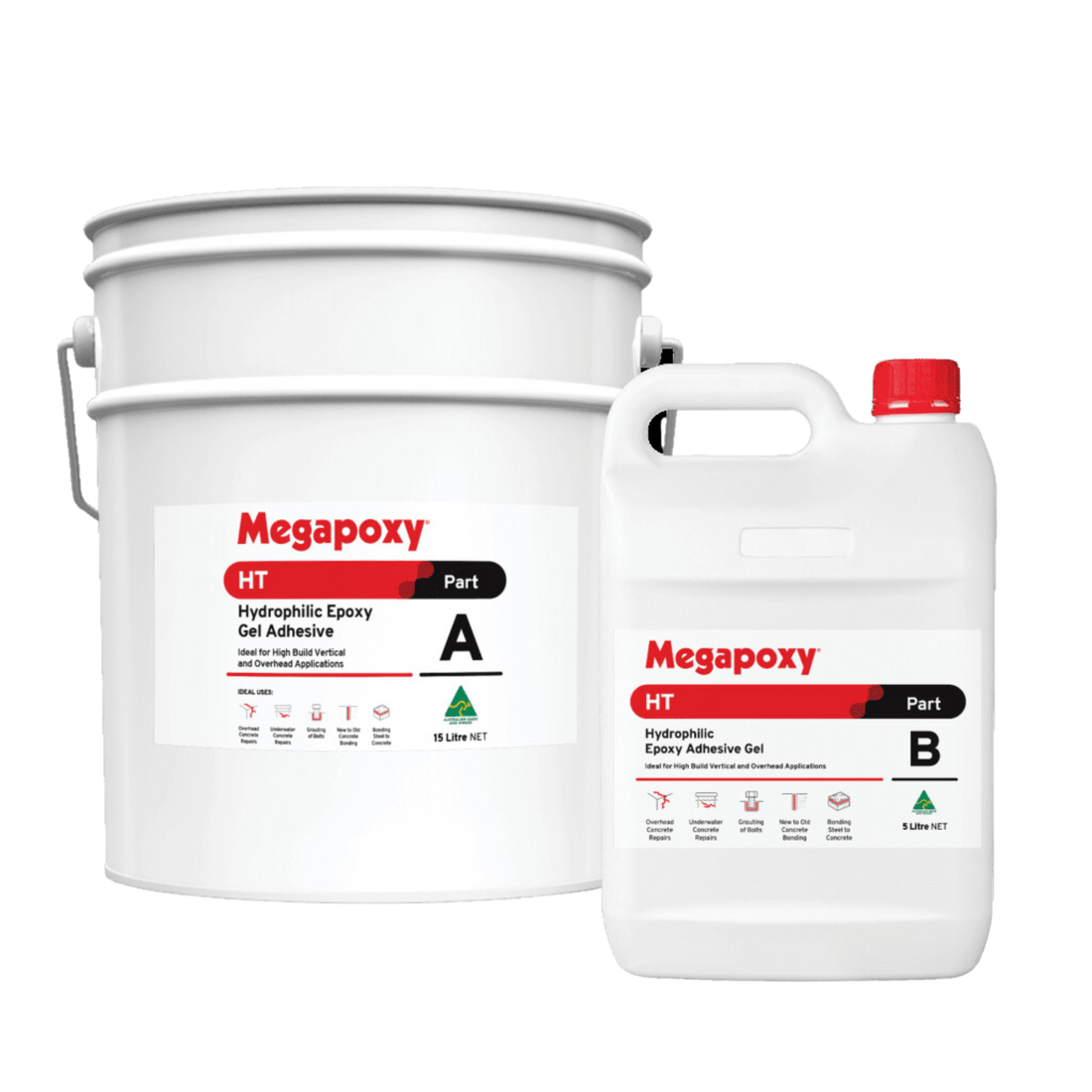
For wet-to-dry concrete bonding, structural repairs, and underwater or splashzone applications, Megapoxy HT is a hydrophilic epoxy gel adhesive that forms permanent bonds on concrete, metal, and steel surfaces. Its formulation is solvent-free, contains no volatile organic compounds (Nil V.O.C.), and resists hydrogen sulphide gas commonly present in sewage treatment plants and pipes.
How it works
Megapoxy HT is a 100% solids, resin-based hydrophilic gel. This chemistry allows it to displace moisture and cure reliably in wet conditions, splash zones, or fully submerged environments. When mixed, it forms a high-strength gel that can be applied by brush, roller, or airless spray. It can be used as a high-strength binder with fine aggregates to produce epoxy mortars and concrete repairs, or applied directly to secure horizontal steel anchoring and wet-to-dry concrete interfaces. For vertical and overhead concrete rendering, its gel consistency provides the necessary sag resistance to hold in place without running.
Numbers that matter
-
36 MPa slant shear strength: High-strength structural bond capacity for critical new-to-old concrete bonding interfaces.
-
100 MPa compressive strength (ASTM D695): Superior load-bearing capability under compressive force, making it stronger than the surrounding concrete.
-
20 MPa tensile bond strength on steel (ASTM D897): High-adhesion anchoring performance when securing steel bars and rods into concrete.
-
15-minute concrete placement window: For new-to-old concrete bonding, the new concrete mix must be poured within 15 minutes of applying the adhesive layer to ensure a proper bond.
-
Cure windows by temperature: Reaches functional cure in 12 hours at 35°C, 24 hours at 25°C, and 48 hours at 15°C. Minimum application temperature is 10°C.
-
30-minute work time (at 25°C): Practical open time to mix, apply, and align substrates before the gel begins to set.
Where to use it
- New to old concrete bonding and concrete crack repairs
- Underwater and splashzone concrete repairs
- Horizontal steel anchoring into concrete
- Floor repairs and high-strength epoxy mortar applications
- Coating applications in high-exposure environments such as sewage treatment facilities
Limitations
- Do not apply if the temperature is below the minimum application limit of 10°C.
- Avoid bonding directly to coated surfaces; existing paint, galvanising, or coatings must be removed first to prevent inferior bond strengths.
- Do not rely on wire brushing for metal preparation; wire brushing provides minimal adhesion only. Metals must be grit blasted or mechanically abraded to a bright finish.
- Part A and Part B must be thoroughly mixed at the precise 3:1 by volume ratio. Inaccurate mixing or poor blending will lower physical properties, prevent a complete cure, and cause discolouration over time.
Substrate preparation and application
Concrete: Ensure the surface is free from grease, oil, and laitance. Mechanical abrasion via scabbling, grit blasting, or grinding is preferred. If acid etching is required, apply a 1:1 hydrochloric acid and water mix at 0.5 litres per square metre, allow to react for 10 minutes, scrub with a stiff broom, wash thoroughly, and let dry for 24 hours. For maximum adhesion, the concrete should be surface dry before application.
Metal: Grit blast to AS CK 9.4 - 1964 Class 3 finish, or mechanically abrade to bright metal. Degrease by flooding the prepared surface with an industrial grade degreaser. For steel anchoring, drill a hole approximately 1.5 times the steel diameter, blow out dust using oil-free, dry compressed air, set the steel, and pour the mixed adhesive from one side to prevent air entrapment.
Coated surfaces: For concrete, remove paint via flame-cleaning or scutching, followed by diamond grinding or scabbling. For metals, remove paint and galvanising with a paint stripper, then grit blast or grind to a bright metal finish.
Clean-up: Clean all mixing tools and application equipment immediately after use with Megapoxy Thinners.