





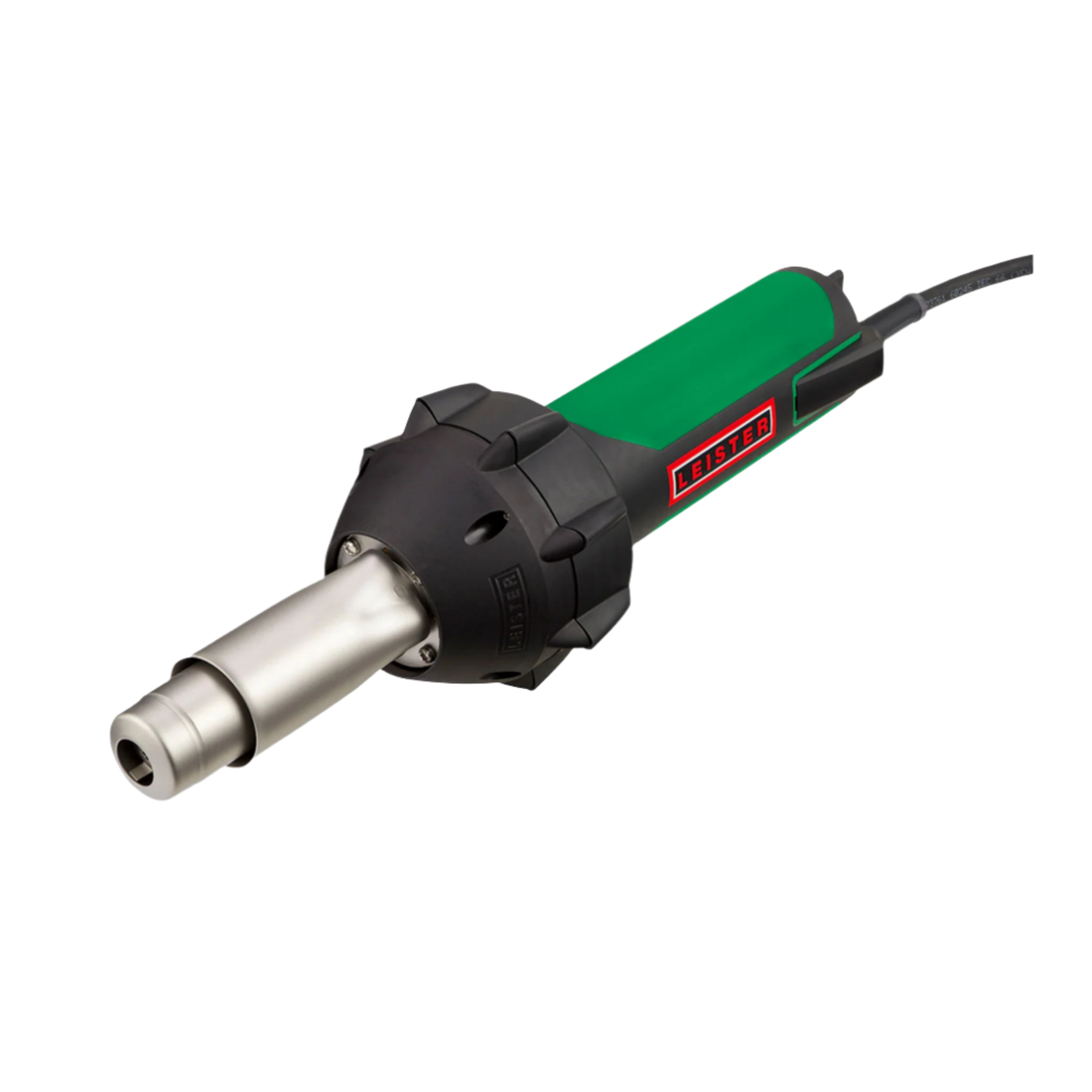


Leister Triac ST Heat Gun is a professional-grade thermal welding tool engineered for the rigorous demands of membrane roofing and civil containment. This 1600W unit combines a stepless 40–700 °C temperature range with a lightweight 0.99 kg construction to help consistent overlap welding and HDPE fusion without operator fatigue.
Featuring Swiss-engineered analog circuitry and IP Class II protection, it eliminates the risk of digital screen failures or error codes often triggered by cold starts or fluctuating generator power on remote jobsites.
Frequently asked questions
Is the TRIAC ST compatible with Australian 10A power outlets?
Yes, the TRIAC ST operates at 230 V / 1600 W and ships with a 10A, 3-pin AU plug. This makes it fully compliant with standard Australian jobsite and workshop power outlets.
What materials can this heat gun weld?
The TRIAC ST is designed for welding thermoplastics such as PVC, TPO, HDPE, LDPE, PP, and coated fabrics. It is not suitable for non-thermoplastic materials like metals or composites.
Does the TRIAC ST have adjustable airflow?
No, the TRIAC ST provides a fixed airflow of 240 l/min. This consistent airflow ensures stable heat delivery without requiring separate fan control.
Can I use TRIAC AT nozzles with the TRIAC ST?
Yes, the TRIAC ST uses a ø31.5 mm (M14) nozzle connection. This is compatible with over 80 Leister welding and forming nozzles, including standard attachments for the TRIAC AT.
Is the TRIAC ST suitable for continuous site work?
Applications and benefits
| Application | Key benefit | Primary trades |
|---|---|---|
| Welding PVC and TPO roofing membranes | Delivers consistent fusion with analog controls, reducing digital failure risks on exposed rooftops. | Roofers, Waterproofers |
| Repairing HDPE liners for tanks and bunds | Ensures reliable heat delivery in remote or dusty environments, compatible with portable generators. | Civil Contractors, Environmental Engineers |
| Heat shrinking cable wraps or sheathing | Provides steady airflow and reliable heat for precise work in cable trays and overhead conduits. | Electricians, Communications Technicians |
| Patching and forming coated tarpaulin | Lightweight, ergonomic design supports handheld use with Leister slit nozzles for fabrication and repair. | Canvas Workers, Awning Repairers |
| Detail welding for commercial vinyl flooring | Offers fine control over positioning, allowing access into tight corners without operator fatigue. | Flooring Installers |
Applying Leister TRIAC ST Heat Gun: Enhanced Protocols & Best Practices
-
Step 1: Prepare the Work Area
Ensure a safe, dry, well-ventilated environment. Lay out substrate material and select the appropriate nozzle for the job.
Membrane Welding
Position membranes with a minimum 40 mm overlap. Clamp or weight ends to prevent wind interference. Clean mating surfaces with a dry cloth.
Plastic Forming
Secure the workpiece using clamps or formers. Pre-clean the surface to remove dust or release agents.
Timing: 2–3 minutes setupPro Tip: Use a grounded RCD-protected circuit and avoid plug adaptors or boards. -
Step 2: Power Up and Preheat
Plug into a 230 V outlet. Turn the analog dial to the desired heat level — refer to material guidelines for temperature estimates.
PVC Roofing Membranes
Set to approx. 550–600 °C for 1.5 mm PVC with a slit nozzle. Allow 45 seconds to reach temp.
HDPE Liner Patching
Use a wide-slot nozzle and set to 600–650 °C. Test on scrap material before welding live seams.
Timing: Heats up in 30–60 secondsPro Tip: Always test your heat setting on offcut material before starting production welds. -
Step 3: Perform Welding or Forming
Maintain a consistent angle and motion. Use Leister rollers to apply pressure during overlap welding or shaping.
Overlap Welding
Insert the nozzle between overlapped membranes. Move steadily along the seam while pressing with a silicone roller to form a strong bond.
Forming Acrylic or Polycarbonate
Heat slowly from a distance with low-to-mid setting. Flex into jigs or forms gradually to avoid stress fractures.
Timing: 5–10 seconds per 300 mm weld (approx.)Pro Tip: Avoid overheating. Bubbling or charring indicates excessive temperature or slow movement. -
Step 4: Power Down and Cool
Turn off the heat dial and unplug the gun. Allow the unit to cool naturally before storing or moving it.
Jobsite Use
Place on a heat-safe surface or cradle. Do not coil the cable while the unit is hot.
Workshop Storage
Clean nozzle with a dry cloth once fully cool. Store in its case or protective sleeve.
Timing: 2–3 minutes natural cool-downPro Tip: Never dunk or rapidly cool the nozzle — thermal shock can crack the heating element.
Product limitations
- Not for precision temperature: The TRIAC ST lacks a digital temperature readout. For applications requiring exact temperature regulation and monitoring, consider the Leister TRIAC AT.
- Not for non-thermoplastics: This tool is not suitable for welding materials like metal, wood, or epoxy composites.
- Fixed airflow: The fixed airflow of 240 l/min may not suit highly delicate plastics that require lower air pressure.
Safety and handling
Personal protective equipment
Wear heat-resistant gloves during use. Safety glasses are recommended when working with overhead seams or around softening plastic. Avoid loose-fitting clothing near the air intake.
Ventilation
Use in a well-ventilated area. When heating PVC or other coated materials, ventilate the space to avoid exposure to potentially harmful off-gases.
First aid
- Eyes: Flush with cool water immediately for at least 15 minutes. Seek medical attention if irritation persists.
- Skin: For burns, rinse with cool water and apply sterile gauze. Do not use creams or ointments unless directed by a medical professional.
- Inhaled: Move the individual to fresh air. If breathing difficulties occur, seek immediate medical assistance.
Storage and disposal
Do not leave the tool unattended while hot or plugged in. Always place it on a non-flammable, heat-resistant surface. Never rest the nozzle directly on materials or floors. Dispose of electrical waste according to local regulations.
Substrate guide
Understanding substrate preparation and heat settings is key for a strong weld. This guide outlines standard approaches for common thermoplastics welded with the Leister TRIAC ST.
PVC (Polyvinyl Chloride)
Surface prep: Clean the surface with a dry cloth before welding. Ensure it is free of dust and contaminants.
Welding range: Set the tool between 500–600 °C. Use a slit nozzle for seams.
Primer: Not required. The TRIAC ST welds PVC directly, achieving excellent fusion with standard Leister overlap nozzles.
TPO (Thermoplastic Polyolefin)
Surface prep: Clean the material with isopropyl alcohol (IPA) before welding to remove any surface oils or dirt.
Welding range: Recommended temperature is 550–620 °C. Use a slit or wide-slot nozzle. Apply steady pressure and maintain an overlap technique. Test seam strength after cooling.
Primer: Not required.
HDPE / LDPE (Polyethylene)
Surface prep: Ensure the surface is clean and dry. Use a wide-slot nozzle.
Welding range: Set to 580–650 °C. Polyethylene softens quickly; test a small area first. Keep the heat gun moving continuously to avoid surface burns.
Primer: Not required.
Coated Fabrics / Tarpaulins
Surface prep: Gently clean the fabric with a soft cloth to remove dirt without damaging the coating.
Welding range: Approximately 520–580 °C. Use a flat or slit nozzle with a low angle to prevent overheating edge coatings. Suitable for banners, awnings, tents, and truck tarps.
Primer: Not required.
Leister Triac ST Heat Gun Physical Properties
| Property | Value |
|---|---|
| Voltage | 230 V |
| Power | 1600 W |
| Frequency | 50/60 Hz |
| Temperature Range | 40–700 °C |
| Temperature Setting | Stepless (Analog Dial) |
| Airflow | 240 l/min (Fixed) |
| Air Volume Adjustment | No |
| Static Pressure | 3000 Pa |
| Display | No |
| Outdoor Use | Yes |
| Nozzle Connection | ø31.5 mm / 1.25 in (M14 thread) |
| Length | 338 mm |
| Device Diameter | 90 mm |
| Handle Diameter | 56 mm |
| Weight | 0.99 kg (without cable) |
| Power Cable Length | 3.0 m |
| Noise Emission Level | 67 dB(A) |
| Protection Class | II |
| Plug Type | AU, 3-pin, 10A |
| Approvals | CE, UL, KC, S+ |
| Country Of Origin | Switzerland |