







Download Product Data
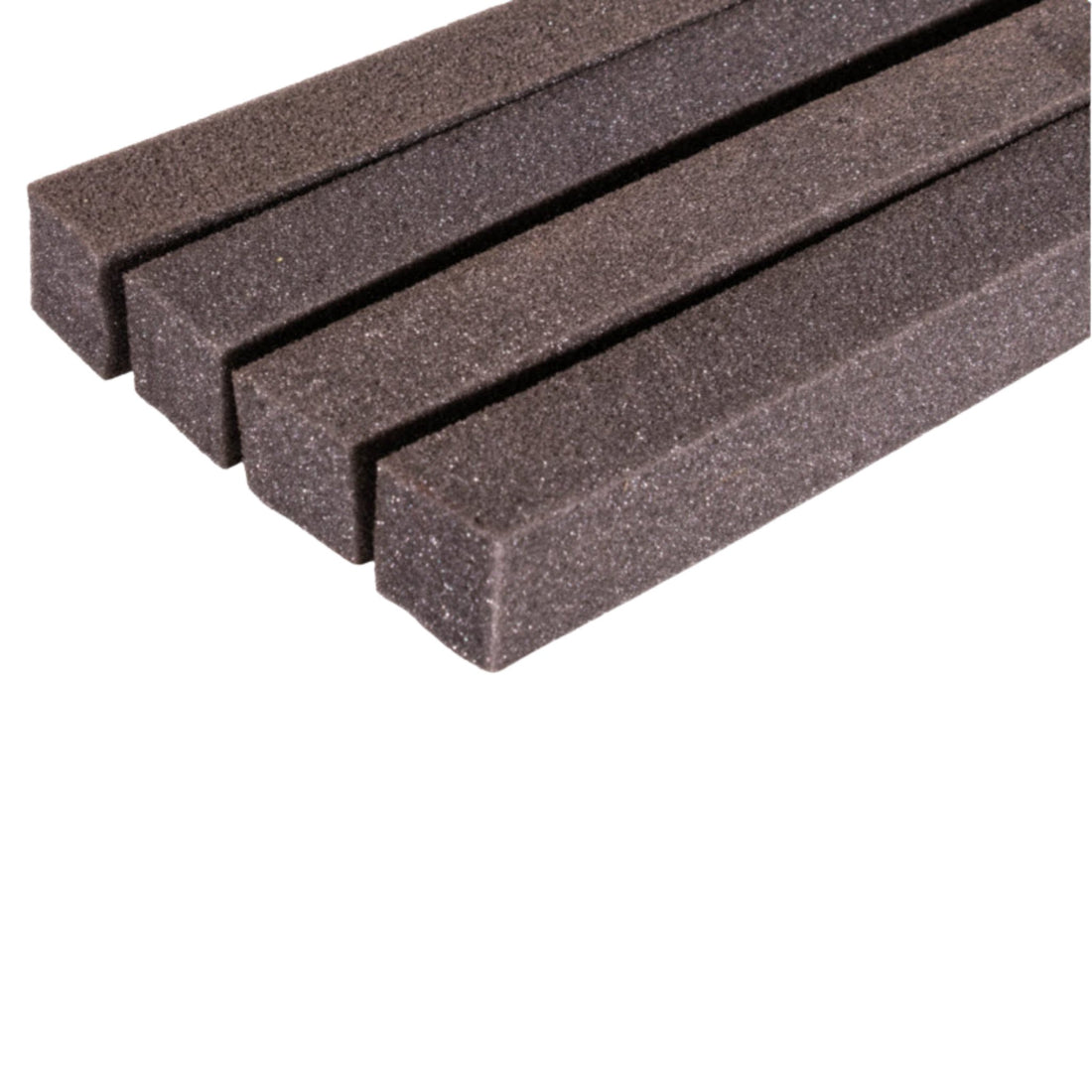
For sealing expansion joints, roof cladding, and window or door perimeters against weather, Biyseal Acrylic Impregnated Foam provides a highly compressible barrier that adapts to continuous joint movement. This high-density polyurethane foam is impregnated with an acrylic solution, allowing it to expand and contract dynamically while maintaining its elasticity indefinitely.
How it works
Biyseal Acrylic relies on physical compression to block environmental elements. The level of protection scale directly with how much the foam is compressed during installation. It can be compressed down to 10% of its original width and will recover to more than 90% of its dimension after repeated compression and expansion cycles.
Numbers that matter
- 25% compression: The minimum threshold required to form a reliable seal against air, dust, and vibration.
- 50% compression: The compression level required to establish a secure seal against moisture.
- 75% compression: The level required to seal joints against heavy rain and direct water ingress.
- -10°C to +70°C: The service temperature range across which the foam maintains its sealing performance.
Where to use it
This foam is suitable for sealing a variety of joints and interfaces, including:
- Roof cladding across all standard roofing materials and Custom Orb profiles.
- Back channel foam for polycarbonate sheet installations.
- Expansion joints in concrete and brickwork.
- Window and door perimeters adjacent to concrete, timber, and brickwork.
- Precast concrete panels, air-conditioning systems, and partitions.
- Weather-exposed electrical installations.
- Caravans, motor vehicles, and railway carriage construction.
Installation and handling
Surfaces must be clean and free of grease and oils before application. Ensure the selected foam dimension matches the joint size to achieve the required compression rate. Compress the foam by hand or with a roller immediately before placing it into the joint; the foam will expand quickly to fill and seal the gap. When joining multiple strips, splice the ends at an angle using a wet knife to ensure a continuous joint. Store unused stock away from dust and direct sunlight.
Compatibility and limitations
Biyseal Acrylic is compatible with water-based paints and mastics. Ensure foam dimensions are verified against actual joint widths to prevent under-compression, which compromises the seal against water and drafts.
How much should Biyseal Acrylic be compressed?
The required compression depends on the exposure: about 25% for air and dust, 50% for moisture and 75% for heavy rain or direct water.
What service temperature range is stated?
-10°C to 70°C.
How should strips be joined?
Splice the ends at an angle with a wet knife to maintain a continuous seal.
Can it be used around windows and doors?
Yes. Window and door perimeter sealing is one of the listed applications.
- Roof and wall cladding.
- Concrete and brick expansion joints.
- Window and door perimeters.
- Precast concrete panels.
- Polycarbonate back-channel details.
- Air-conditioning, partition and weather-exposed service details.
Biyseal Acrylic Impregnated Foam Physical Properties
| Property | Value |
|---|---|
| Material | Polyurethane Foam, Acrylic Solution Impregnation |
| Compression Performance | 25% blocks air, dust, vibration; 50% blocks moisture; 75% blocks rain and water |
| Elastic Recovery | Recovers to over 90% of original width after repeated compression |
| Application Temperature | -10°C to +70°C |
| Substrate Compatibility | Water-based paints and mastics |
| Available Sizes | 25mm x 25mm, 50mm x 25mm |
| Length Per Strip | 2 m |