





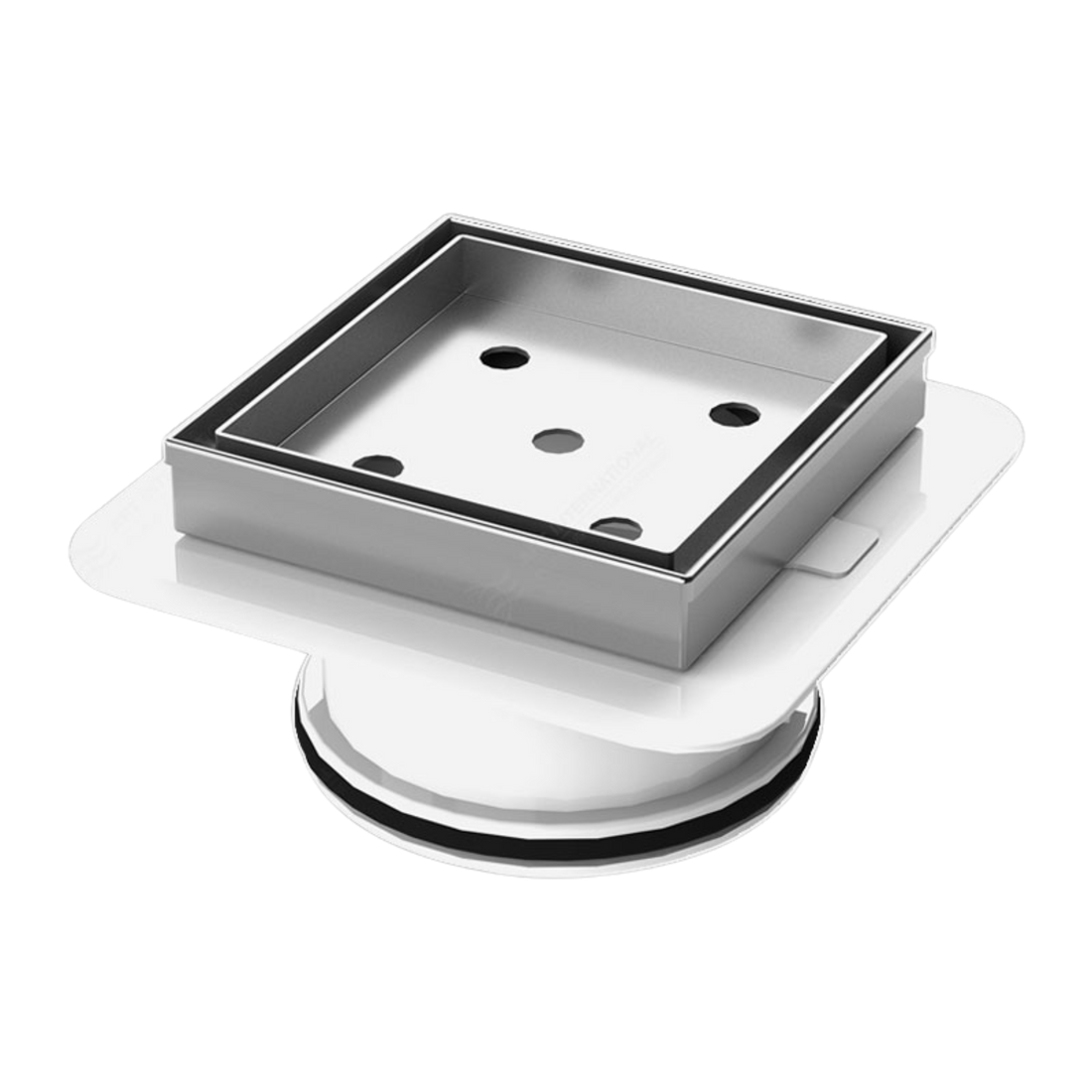

Why Choose 316 Stainless Steel Square Tile Insert with Megaflex Outlet
Use 316 Stainless Steel Square Tile Insert with Megaflex Outlet for floor drains in wet areas where a marine-grade metal tray meets a flexible ABS base. This combination delivers proven corrosion resistance in high-moisture and coastal environments while allowing plumbers to connect to slightly offset DWV pipe during renovation.
316 Stainless Steel Square Tile Insert with Megaflex Outlet Common Uses
Use this floor waste system where concealed drainage must remain visually unobtrusive beneath floor tiles and where plumbing alignment may be compromised by legacy building movement.
- Wet areas and tiled showers where 316 marine-grade steel resists cleaning-agent corrosion.
- Laundries and coastal balconies that demand long-term salt and chemical resistance.
- Renovation sites with non-ideal pipe alignment, leveraging Megaflex flexibility for secure DWV connections.
Where 316 Stainless Steel Square Tile Insert with Megaflex Outlet Performs Best
Performs reliably on slab or concrete substrates where the total tile and adhesive build stays within 12.8mm and the environment exposes the assembly to moisture, chlorides, or cleaning chemicals.
Coverage, Skin Time & Cure
Yield and timing data support site planning to ensure full coverage and proper cure before traffic or waterproofing over the insert.
- Unit design allows integration within standard tile thickness limits up to 12.8mm to maintain a flush, trip-free surface.
- Storage conditions: 5 to 35°C in a dry indoor environment; shelf life remains indefinite when stored according to guidelines.
- Site-plan to protect the insert from early surface damage; tooling off should align with tile setting schedules.
Surface Prep & Application
Prepare the substrate and install the insert as part of a coordinated waterproofing and tiling sequence to maintain membrane integrity.
- Integrate the floor waste flange with the waterproofing membrane system in accordance with AS 3740 and the membrane manufacturer’s specifications; this is a critical step.
- Ensure the waste body is level and securely fixed before tiling to support even load distribution.
- Cut the tile insert tray to accommodate the tile thickness, keeping total build within the 12.8mm limit to preserve a flush finish.
- Use compatible floor tiles that fit the internal tray dimensions of 94 x 94 mm for precise cutting and placement.
- After installation, rinse cleaning residues from the stainless steel frame; avoid harsh, abrasive, or acidic cleaners that may dull the polished finish.
Best Practices for Using 316 Stainless Steel Square Tile Insert with Megaflex Outlet
Combine the insert with compatible primers and membrane systems to reduce the risk of drainage blockage and to protect the polished metal surface during construction.
- Follow AS 3740 waterproofing and plumbing code requirements for full compliance.
- Schedule tooling and final tile setting to avoid premature handling that could scratch the frame.
- Use the flexible ABS base to accommodate slight pipe misalignment, but verify final alignment before grouting.
- Regularly lift and clean the tile-insert tray to prevent drainage blockage from debris.
Handling & Storage
Handle and store the insert to protect the 316 steel finish and the structural integrity of the Megaflex base.
- Wear appropriate PPE and ensure ventilation when applying site cleaners or rinses.
- Store units in a dry indoor environment within 5 to 35°C.
- Keep the original protective films in place until installation to prevent surface scratching.
- Dispose of packaging and damaged components in accordance with local regulations.
- Do not use abrasive cleaners or acidic agents directly on the polished stainless steel surface.
Frequently asked questions
What is the maximum tile thickness for this insert?
The tile insert tray has a recess depth of 12.8mm. This accommodates most standard ceramic, porcelain, or stone tiles, plus adhesive. Dry-fit your chosen tile to ensure a flush finish.
Is 316 Marine Grade Stainless Steel required for indoor use?
316 Marine Grade stainless steel offers superior corrosion protection over 304 grade, especially in wet areas with cleaning products or residual salts. It ensures long-term integrity and appearance, reducing future callbacks.
How does the Megaflex base assist installation?
The Megaflex A.B.S. base provides a degree of flexibility. This helps plumbers achieve a secure connection to the waste pipe, particularly when existing pipework is not perfectly aligned during renovations.
Can this floor waste be used in outdoor tiled areas?
Yes, its 316 Marine Grade Stainless Steel and A.B.S. construction makes it suitable for outdoor tiled areas like balconies. Ensure the drainage and waterproofing comply with Australian Standards, such as AS 4654.2.
What is the recommended cleaning method?
Simply lift the insert tray and remove debris from the drain body beneath. Clean the stainless steel frame with a soft damp cloth and mild, non-abrasive detergent. Avoid harsh chemicals or abrasive scourers to protect the polished finish.
Applications and benefits
| Application | Key benefit | Primary trades |
|---|---|---|
| Residential bathrooms and laundries | Ensures long-term corrosion resistance and maintains aesthetic integrity in wet environments. | Plumbers, Tilers |
| Commercial kitchens and wet areas | Provides high durability and hygiene from 316 Marine Grade Stainless Steel construction. | Builders, Plumbers |
| Outdoor tiled areas like balconies | Withstands moisture and environmental exposure, preventing corrosion and staining. | Waterproofers, Tilers |
| Renovation projects with existing pipework | Flexible Megaflex™ ABS base simplifies pipe alignment and connection. | Plumbers |
Step-by-Step Installation Overview for ART International Tile Insert Floor Waste:
Note: Installation must be performed by a licensed plumber and tiler in accordance with AS/NZS 3500, AS 3740, and local building codes. This is a general guide only.
-
Plumber - Preparation & Body Installation:
- Determine correct floor waste location and ensure subfloor is prepared.
- Connect the Megaflex™ A.B.S. waste body [cite: 1, 6, 11] to the appropriate sized (50mm, 80mm, or 100mm [cite: 2, 7, 12]) DWV pipe using approved plumbing methods.
- Set the height of the waste body carefully, accounting for screed depth (if any), waterproofing membrane thickness, tile adhesive bed, and the tile thickness itself. The aim is for the top of the tile insert tray, once installed, to sit perfectly flush with the surrounding finished floor tiles.
- Ensure the waste body is level and securely fixed.
-
Waterproofer/Tiler - Waterproofing & Screed:
- Integrate the floor waste flange with the waterproofing membrane system according to AS 3740 and waterproofing manufacturer’s specifications. This is a critical step.
- Install screed (if required) ensuring correct falls are achieved towards the floor waste for effective drainage.
-
Tiler - Tiling & Tile Insert Installation:
- Tile the main floor area, working towards the floor waste. Leave an appropriate opening for the waste.
- Precisely cut a piece of your chosen floor tile to fit into the stainless steel tile insert tray (internal dimensions approx. 94mm x 94mm). The tile should be no thicker than approx. 12.8mm.
- Using a suitable wet area tile adhesive, fix the cut tile into the insert tray, ensuring it is level and flush with the top edges of the tray. Remove any excess adhesive immediately.
- Once the adhesive in the tray is set, place the completed tile insert into the floor waste body.
- Grout the surrounding floor tiles as per normal practice.
-
Final Checks:
- Ensure the tile insert is easily removable for cleaning access.
- Check for correct drainage once all plumbing fixtures are commissioned.
- Protect the finished waste during any remaining construction activity.
Product limitations
- Not for: Tiles exceeding 12.8mm thickness. Using thicker tiles will cause the insert to sit proud of the finished floor.
- Not for: High-load or vehicular traffic areas. This floor waste is designed for standard pedestrian traffic only.
- Use: Avoid harsh, abrasive, or acidic cleaners directly on the polished stainless steel frame. These chemicals can dull or scratch the finish over time. Always rinse with clean water after cleaning.
- Installation: All plumbing and tiling work must be carried out by licensed professionals in accordance with AS/NZS 3500 and AS 3740.
- Waterproofing: Correct integration of the floor waste flange with the waterproofing membrane is critical and must be completed by a qualified waterproofer.
Safety and handling
Storage and disposal
Protect the polished stainless steel finish from scratches or damage during storage, handling, and installation. Keep protective films on as long as practical. The product has an indefinite shelf life under proper storage conditions.
Substrate guide
This guide details compatible floor tile types and specific preparation points essential for correct installation and a flush finish.
Compatible floor tiles
Surface prep: The tile insert tray accepts tiles up to approximately 12.8mm thick. This includes most ceramic, porcelain, natural stone, and mosaic tiles. Dry-fit tiles to confirm thickness. For natural stone, seal if porous as per manufacturer's instructions.
Primer: Not required for the waste unit itself. Standard tile system primers apply to the surrounding floor area as needed.
316 Stainless Steel Square Tile Insert with Megaflex Outlet Physical Properties
| Property | Value |
|---|---|
| Material | 316 Marine Grade Stainless Steel, ABS |
| Finish | Polished Stainless Steel |
| Outlet Sizes | 50mm, 80mm, 100mm |
| Dimensions | 108.4mm x 108.4mm |
| Base Type | Megaflex ABS |
| Storage Temperature | 5°C to 35°C |
| Shelf Life | Indefinite under proper storage |
| Certifications | AS 3500, ISO 9001:2015, AS 2831 Corrosion Resistance |